
If you run a business that sells to other businesses, you already know the sale never happens overnight. There are more people involved in the decision, more objections to work through, and a longer window between first contact and closed deal. That's the reality of B2B selling, and if your marketing isn't built around that reality, you're going to keep losing deals you should have won.
A B2B sales funnel is the system that maps how a business buyer moves from first becoming aware of your offer to actually becoming a paying client. When it's built properly, it aligns your marketing and sales efforts to the actual buying behavior of your prospects. When it's missing or improvised, you end up with inconsistent revenue, a sales team chasing unqualified leads, and no clear visibility into what's working.
In this guide, I want to break down exactly what a B2B sales funnel is, how it differs from a B2C sales funnel, and how to build one that delivers predictable results for your online business.
What is a B2B Sales Funnel?
A B2B sales funnel is a structured framework that describes the stages a prospective business client moves through before making a purchase decision.
At the top, you have a broad pool of potential buyers who are becoming aware of a problem or a solution. As you move deeper into the funnel, that pool narrows to a smaller group of highly qualified prospects who are actively evaluating options, until a segment of those prospects convert into customers.
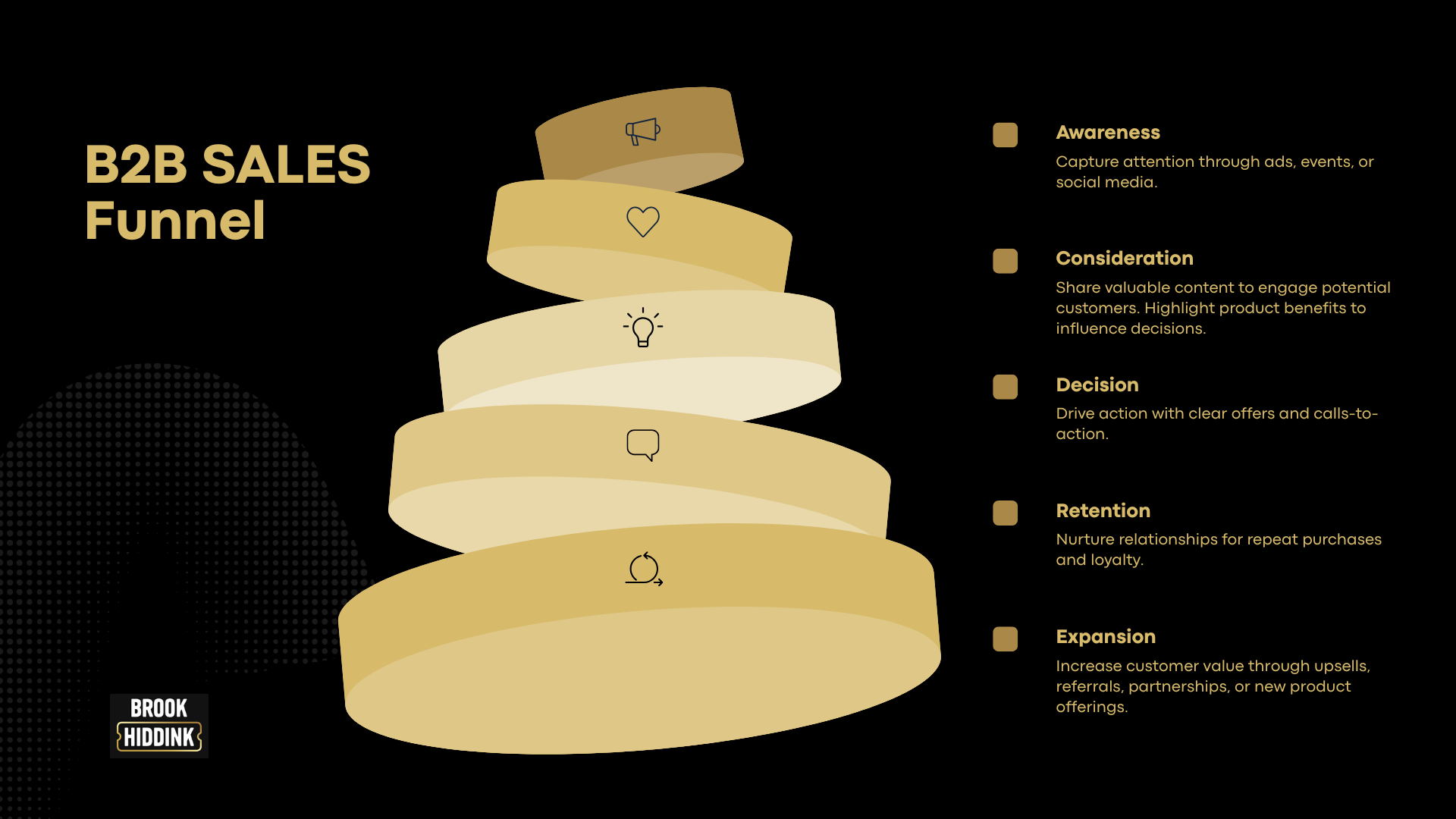
The funnel is a practical guide for knowing what content to produce, what conversations to have, and what systems to build at each point in the buying journey. Most businesses already have some version of a funnel, even if they've never named it. The question is whether yours is intentional and optimized, or disconnected and leaky.
Why B2B Companies Need a Structured Funnel
The average B2B sales cycle lasts over three months from first contact to closed deal, and for high-ticket services or enterprise-level software, it can be longer. This is because a typical B2B purchase involves between six and ten stakeholders, according to research from Gartner, each evaluating the decision from a different angle. The CFO is thinking about cost. The operations lead is thinking about implementation. The end user is considering whether it will make their life easier.
If your funnel isn't designed to address multiple roles and multiple concerns across a longer timeline, you're going to lose deals to the competitor who does. A structured funnel gives you the framework to stay present and relevant at every stage of that process.
Other reasons are:
1. Aligning Marketing and Sales Teams
One of the biggest challenges in B2B businesses is the disconnect between marketing and sales. Marketing focuses on generating leads, while sales expects leads that are ready to convert. When expectations are not aligned, sales teams often complain about poor lead quality, while marketing argues that leads are not being followed up properly. The result is a fragmented customer journey, missed revenue opportunities, and constant friction between teams. Without clear communication, shared goals, and proper lead management processes, businesses struggle to identify where prospects are dropping off and why conversions are slowing down.
A structured funnel solves this by creating a shared map that both teams operate from. Marketing knows which leads are ready to be handed off based on specific behaviors and criteria. Sales knows exactly what content and context those leads have already consumed before the first conversation. The handoff becomes cleaner, the conversations become more productive, and conversion rates improve.
2. Improving Lead Quality and Sales Conversations
A well-structured sales funnel educates and qualifies prospects before they ever speak to your sales team. By the time a conversation happens, prospects already understand your services, trust your expertise, and know how you can help them.
This shifts sales conversations away from basic explanations and toward meaningful discussions about fit, goals, timelines, and next steps. As a result, sales teams spend less time convincing unqualified leads and more time closing high-intent prospects. The outcome is better lead quality, higher conversion rates, and a shorter, more efficient sales cycle.
3. Building Predictable Revenue Growth
Revenue predictability is one of the biggest challenges for service businesses, agencies, and online companies operating in the B2B space. A funnel that's working gives you data at every stage:
- How many leads are entering
- How many are converting
- Where they're dropping off
- How long each stage take?
This data lets you forecast accurately, allocate budget effectively, and scale with confidence.
How the B2B Sales Funnel Works
1. Awareness Stage
At the top of the funnel, the goal is simple: get in front of the right people before they're actively shopping. Most B2B buyers start by searching for information about a problem they're experiencing. If your content shows up during that research phase, you establish early authority and get a head start on trust-building before your competition even enters the picture.
Effective awareness-stage assets include:
- SEO-driven blog content
- YouTube videos
- LinkedIn posts
- Podcast appearances
- Paid traffic campaigns targeted to your ideal buyer profile.
The common mistake here is producing too much general content and not enough content that speaks specifically to the problems your target buyer is living with right now.
2. Consideration Stage
Once a prospect is aware of your brand, the next question is whether you're worth taking seriously as a potential solution. This is where they start comparing options, reading case studies, consuming your more in-depth content, and evaluating whether your methodology matches their needs.
Your consideration-stage assets need to do two things:
- Demonstrate that you understand their problem in detail
- Give them enough evidence of your results to move them closer to a conversation.
Webinars, detailed guides, comparison content, and email sequences work well here. The goal is to stay present and relevant throughout the prospect's evaluation.
3. Decision Stage
At the decision stage, the prospect is ready to buy. They've identified their problem, evaluated options, and narrowed it down. Now they need the final confirmation that you're the right choice. This is where social proof, clear offer presentations, transparent pricing, process information, and a frictionless booking system make the difference.
The mistake most B2B businesses make at this stage is over-complicating the path to a conversation. If booking a call with you requires a prospect to jump through five hoops, you'll lose deals to competitors with simpler processes.
4. Retention and Expansion
The funnel doesn't end at the sale. In B2B, the most efficient source of revenue growth is existing clients. Onboarding sequences, milestone check-ins, client success content, and proactive account management all feed into retention and expansion. According to Bain & Company, increasing customer retention by just 5% can increase profits by 25-95%. The post-purchase stage deserves the same intentional design as the acquisition stages.
B2B Sales Funnel Stages
1. Top of the Funnel (TOFU)
The top of the funnel is where you create awareness and capture attention. Your job here isn't to sell. It's to attract the right people into your ecosystem by offering something useful, for example, lead magnets, educational blog posts, video content, and targeted ads. The best TOFU assets address a specific pain point your ideal buyer is actively experiencing and offer a clear, actionable insight in return for their attention and contact information.
A strong lead magnet in B2B is specific, relevant, and delivers genuine value. Case in point: "A Diagnostic Framework for Identifying Where Your Agency Funnel Is Leaking Revenue" instead of "7 Marketing Tips for Small Businesses."
2. Middle of the Funnel (MOFU)
The middle of the funnel is where most B2B businesses drop the ball. They generate leads, then immediately push for a sales call before the prospect is ready. The result is low show-up rates, skeptical conversations, and a sales team frustrated by cold, unqualified meetings.
The middle of the funnel is where you build trust and demonstrate authority over time. Email sequences, case studies, webinars, and in-depth content that speaks to your prospect's decision-making process all belong here. The goal is to move the prospect from "I've heard of you" to "I believe you can actually solve my problem."
Lead behavior also matters at this stage. Prospects who repeatedly open emails, download resources, click through content, or revisit your website are showing buying signals. Segmenting and prioritizing these engaged leads allows sales teams to focus their outreach on prospects who are more likely to convert.
3. Bottom of the Funnel (BOFU)
The bottom of the funnel is where prospects convert to customers. At this point, your focus shifts from education to removing friction and reinforcing trust. Key BOFU assets include sales pages, application forms, booking systems, proposals, and direct sales conversations. Every element should address common objections, highlight measurable outcomes, and make the next step feel simple and low-risk. Video testimonials, detailed case studies, clear offer positioning, and strong calls to action all play an important role here.
For high-ticket B2B services, conversions often happen through phone or video consultations. The process should feel smooth and professional from start to finish. Use scheduling tools with automated reminders to reduce no-shows, send pre-call questionnaires to gather context in advance, and prepare a structured agenda that keeps the conversation focused and respectful of the prospect’s time.
4. Post-Purchase Funnel Stage
The sales funnel does not end when a prospect becomes a customer. The post-purchase stage is critical for strengthening client relationships, increasing retention, and creating opportunities for referrals and upsells. A structured onboarding process helps set clear expectations, guide clients through the next steps, and deliver quick wins that build confidence in their decision.
Consistent communication after the sale also plays an important role. Milestone check-ins, educational resources, performance updates, and proactive support help clients stay engaged and see ongoing value in your service. Over time, successful client outcomes can be turned into testimonials and case studies that strengthen your credibility and support future sales efforts.
Difference Between B2B and B2C Sales Funnels
B2B vs B2C: The Core Differences
The fundamental difference between B2B and B2C funnels comes down to who makes the decision and what drives it. B2C buyers are often making individual, emotion-driven purchases on a short timeline.
B2B buyers, on the other hand, make organizational decisions that require justification, approval, and careful risk assessment. The funnel you build has to reflect that reality.
Why the B2B Sales Cycle Is Longer
In most B2B purchases, the person who first discovers your solution is not the person who signs the check. There are approval chains, budget cycles, committee reviews, and competing priorities that all slow the process down. A prospect might be genuinely interested but unable to move forward because their company is mid-quarter or in the middle of a hiring freeze. Your funnel needs the patience to stay relevant through those delays without losing the relationship.
Other reasons are:
1. Sales and Marketing Teams Nurturing Leads Over Time
Because the buying journey is long, consistent nurturing is what keeps you in the conversation. Companies that invest in lead nurturing generate 50 percent more sales-ready leads at 33 percent lower cost, according to data from Forrester Research. Email sequences, retargeting campaigns, and regular content distribution keep your brand present and credible throughout the evaluation period.
2. The Role of Trust and Sales Intelligence
B2B buyers evaluate risk as much as they evaluate value. They want to know that the company they're hiring is stable, experienced, and capable of delivering on its promises. You build trust through consistent content, transparent communication, specific social proof, and an organized, professional sales process. Sales intelligence tools like LinkedIn Sales Navigator and Apollo give you the data to reach the right people with the right message at the right time, thereby shortening the cycle and improving lead quality.
How B2C Funnels Work
B2C funnels are built for speed. The goal is to get a prospect from first impression to completed purchase in as few steps as possible. Emotional triggers, scarcity, social proof, and friction-free checkout processes are the primary conversion tools. Also, the buying cycle can be minutes or hours rather than months.
1. Simpler Customer Funnel Journey
A B2C buyer doesn't need a webinar, a discovery call, or a twelve-email nurture sequence before buying a $60 product. The funnel is simpler by design. Traffic lands on a well-optimized product page, a clear offer converts them, and a post-purchase sequence handles upsells and retention.
2. Heavy Focus on Ads and Emotional Triggers
B2C funnels run on paid traffic, primarily because the volume needed to hit revenue targets at lower price points requires scale that organic alone rarely delivers. The creative work focuses on emotion: desire, social proof, fear of missing out, and aspiration. The funnel is optimized for conversion rate at every step.
Which Funnel Model Is Better for Online Businesses?
Neither model is universally better. The right model depends on what you're selling, to whom, and at what price point. If you're selling a coaching program or agency service at $5,000 or above, a B2B-style consultative funnel with multi-touch nurturing will outperform a B2C-style transactional funnel every time. If you're selling a $97 online course to individual consumers, the reverse is true. The mistake is copying the wrong model for your offer.
How to Build a B2B Sales Funnel for Your Online Business
1. Define Your Target Audience
Before you build anything, get specific about who you're targeting. Not "marketing agencies," but "owner-operated digital marketing agencies with five to twenty employees that sell Facebook and Google ads to local service businesses." The more specific your ideal client profile, the more relevant your messaging, and the more efficiently your funnel operates. Generic targeting produces generic results.
2. Create Content for Every Funnel Stage
Map out the questions your ideal buyer is asking at each stage of their journey:
- The problem-awareness questions they're Googling at the top of the funnel
- The comparison and evaluation questions they ask in the middle
- The decision-confirmation questions they need answered before they buy.
Build content that addresses each layer. Most businesses produce too much TOFU content and neglect the middle of the funnel, where deals are actually won or lost.
3. Set Up Lead Capture Systems
Your traffic strategy only creates value if you have a system to capture leads and move them into your funnel. This means a clearly positioned lead magnet, an optimized landing page, and an email platform set up to deliver the lead magnet and automatically begin your nurture sequence. Keep the lead capture process simple, as every additional field on a form reduces your conversion rate.
4. Automate Lead Nurturing
Automation is what makes a funnel scalable. A well-built email sequence delivers the right content at the right time without requiring manual effort for every individual lead. At minimum, build sequences for post-lead-magnet delivery, post-webinar follow-up, and post-call nurturing for prospects who didn't convert immediately. Prospects who don't convert today are often buyers within three to twelve months. A nurture sequence keeps that relationship alive.
5. Align Marketing and Sales
Define the criteria for a sales-qualified lead and make sure both your marketing team and your sales team are operating from the same definition.
- What behaviors indicate readiness?
- How many emails were opened?
- Which pages were visited?
- Did they request a demo or complete an application?
When the handoff criteria are clear and shared, both teams work more effectively, and the lead experience improves.
Essential B2B Sales Funnel Metrics to Track
After setting your funnel, here are the main funnels to track:
1. Conversion Rate by Funnel Stage
Track the percentage of people moving from each stage to the next: visitor to lead, lead to qualified prospect, prospect to booked call, call to client. Your weakest conversion point is where to focus your optimization effort first.
2. Sales Cycle Length
How long does it take, on average, to move a lead from first contact to closed deal? Tracking this over time tells you whether your nurturing and sales processes are improving and helps you forecast revenue more accurately.
3. Customer Acquisition Cost (CAC)
What does it cost you, in total marketing and sales spend, to acquire a single new client? CAC needs to be measured against customer lifetime value to determine whether your funnel economics are sustainable.
4. Lead-to-Customer Ratio
What percentage of the leads you generate actually become paying clients? This number tells you a lot about lead quality, nurture effectiveness, and the strength of the sales process.
5. Customer Lifetime Value (CLV)
CLV tells you how much revenue a client generates over the full course of the relationship. A high CLV justifies a higher CAC and a more resource-intensive acquisition funnel. If your CLV is high, you can afford to invest more in building a sophisticated, high-touch funnel.
Common B2B Sales Funnel Mistakes to Avoid
Some common mistakes to avoid are:
1. Treating B2B Like B2C
This is probably the most expensive mistake I see online business owners make. They buy a B2C funnel course, apply the same pressure tactics and fast-close playbook to a B2B offer, and wonder why their conversions are low. High-ticket B2B prospects need to trust you before they commit. Speed-to-close strategies that work in B2C come across as pushy and undermine that trust.
2. Ignoring the Middle of the Funnel
The middle of the funnel is where most deals are decided. Prospects are evaluating you against alternatives, working through objections internally, and building confidence in their decision. If you have nothing in place to support that process, you're leaving it to chance.
3. Poor Alignment Between Marketing and Sales Teams
If your marketing team is measuring success by lead volume and your sales team by closed deals, you have misaligned incentives. Marketing will generate quantity. Sales will get frustrated with the quality. The fix is a shared definition of what qualifies a lead for sales outreach and regular communication between the two teams about what's working and what isn't.
4. Focusing Only on Lead Volume
More leads don't solve a broken funnel. If your conversion rate from lead to client is two percent, doubling your lead volume just doubles the amount of noise your sales team has to work through. Fix your conversion rates first, then scale lead volume.
5. Not Optimizing Funnel Metrics
A funnel you don't measure is a funnel you can't improve. Set up your analytics, track your conversion rates at each stage, and review that data on a regular cadence. Small improvements in conversion rate compound significantly over time.
Best Tools for Building a B2B Marketing Funnel
CRM Tools
- HubSpot is the most accessible entry point for most small to mid-size B2B businesses. The free CRM is genuinely functional, and the paid tiers add increasingly powerful automation and reporting.
- Salesforce is the enterprise standard. It's powerful and deeply customizable, but it's also complex and expensive. Unless your sales volume justifies the investment, it's probably more than you need.
- Pipedrive is a solid option for sales-focused teams that want a clean, visual pipeline without the overhead of a full marketing suite.
Email Marketing and Automation Platforms
- ActiveCampaign is my go-to recommendation for most B2B funnels. The automation is flexible, the segmentation is strong, and the CRM integration works well.
- Mailchimp is fine for basic email marketing, but it's limited for complex B2B automation workflows.
- Klaviyo built its reputation in e-commerce but has since expanded into B2B SaaS, offering solid segmentation and behavioral trigger functionality.
Read more: 7 Secrets of the Ecommerce conversion funnel
Funnel Analytics and Reporting Tools
- Google Analytics is the baseline. If you're not tracking traffic sources, landing page performance, and conversion events, start here.
- Hotjar gives you behavioral data through heatmaps and session recordings. It's useful for identifying where prospects drop off on landing and sales pages.
- A properly configured funnel tracking dashboard inside your CRM or a tool like Databox lets you see stage-by-stage conversion rates in one view, which is where the real diagnostic work happens.
Sales Intelligence Tools
- LinkedIn Sales Navigator is worth the investment if your ideal buyers are active on LinkedIn. The targeting filters and InMail functionality give you direct access to decision-makers.
- Apollo combines a large contact database with outreach automation, making it useful for outbound prospecting at scale.
- ZoomInfo is a premium sales intelligence platform with deeper company data and more robust intent signal tracking, suited for larger sales teams with significant outbound volume.
Conclusion
A B2B sales funnel isn't a luxury for businesses at a certain scale. It's the infrastructure that makes consistent, predictable revenue possible, regardless of where you are right now. If you're currently relying on referrals, ad-hoc outreach, or the hope that interested prospects will find their way to a buying decision on their own, a structured funnel is the single most important thing you can build.
The businesses that win in the B2B space are the ones that take the buyer's journey seriously. They show up at every stage with the right content, systems, and conversations. They earn trust before they ask for the sale. And they measure their results carefully enough to know what's working and what to fix.
If you want to build a funnel that consistently converts qualified B2B prospects into high-ticket clients, start with your ideal buyer, map their journey, and build a system that meets them where they are. The revenue will follow.
Ready to transform your funnel into a conversion machine? Check out our comprehensive sales funnel service or DM me on Instagram if you have more questions. I personally respond to every message.
Frequently Asked Questions About B2B Sales Funnels
What is the difference between a B2B sales funnel and a B2C sales funnel?
A B2B sales funnel is designed for a longer buying cycle, involving multiple decision-makers and a higher-stakes purchase. It relies on education, trust-building, and relationship development over time. A B2C funnel is built for speed and individual emotion-driven decisions, typically at a lower price point with a shorter path to conversion.
What are the key stages of a B2B sales funnel?
The core stages are awareness, consideration, decision, and retention. In practice, this translates to: attracting the right audience, nurturing prospects through education and proof, converting qualified leads into clients, and retaining and expanding those relationships after the sale.
How long is a typical B2B sales cycle?
For most online B2B service businesses, the cycle runs between four and twelve weeks from first contact to closed deal. For enterprise-level sales or high-complexity services, it can extend to six months or more. The clarity of your offer directly influences the length of your cycle, the strength of your nurturing sequence, and how effectively your funnel addresses buyer objections before the sales conversation.
What metrics should I track in a B2B funnel?
At a minimum, track conversion rates at each funnel stage, sales cycle length, customer acquisition cost, lead-to-customer ratio, and customer lifetime value. These five numbers give you a clear picture of where your funnel is healthy and where it's leaking.
What is the best marketing funnel strategy for online businesses?
The right strategy depends on your offer, price point, and buyer profile. For high-ticket service businesses, a content-driven authority funnel with a webinar or lead magnet at the top and a consultative sales call at the bottom consistently outperforms other models. Build trust first. Let the sale follow naturally.
How do I improve my B2B conversion rate?
Start by identifying your lowest-converting funnel stage and focusing all of your optimization effort there. Common fixes include more specific lead magnets, better email nurture sequences, improved pre-call qualification, and stronger social proof on your sales page. Don't try to optimize everything simultaneously. Fix your biggest leak first.