
Customer journey mapping is the process of drawing out every interaction a customer has with your brand, from the first ad they see through to the moment they buy and everything after. A good map is grounded in what customers actually do, feel, and think at each stage, rather than what you assume they do.
This article covers the core components of a journey map, the benefits it produces, how to ground it in real data, and how AI tools are changing what you can do with it.
Key Takeaways
- A customer journey map shows every touchpoint and experience a customer has with a brand, giving teams a single reference point across every channel.
- According to Fullstory, journey maps are known to help businesses increase their ROI by 13 to 22 percent when done correctly.
- Maps built on real behavioral data surface friction points that internal assumptions routinely miss.
- AI tools can help process large volumes of interaction data faster than manual review allows.
- In a high-ticket store, where each sale carries a large profit, fixing the right friction point can be worth more than simply buying more traffic.
Purpose and Components of Customer Journey Maps
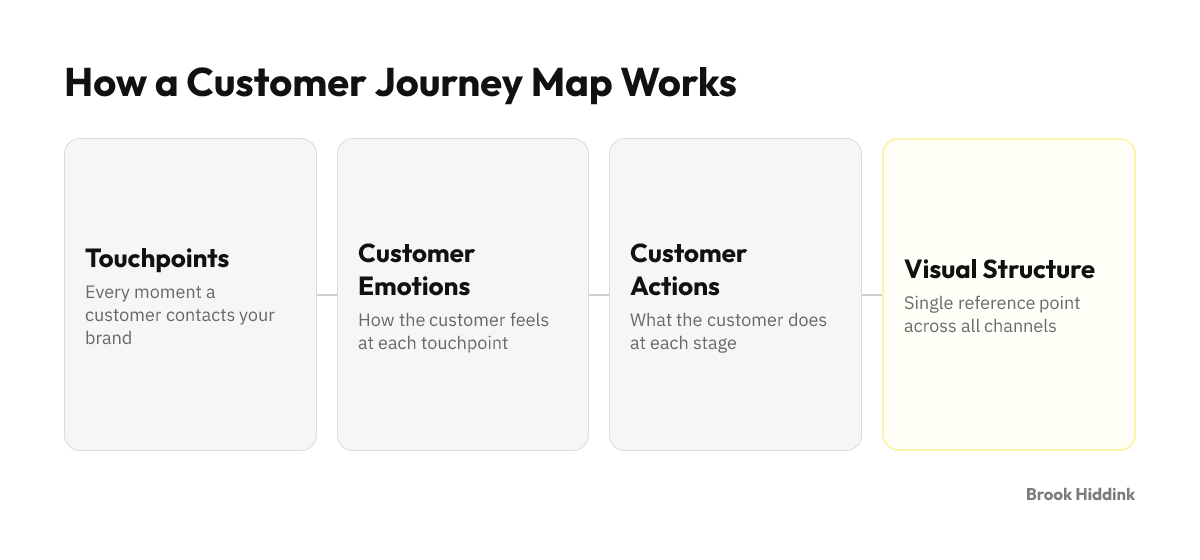
A journey map gives you a single reference point for every interaction a customer has with your brand, from first discovery through to post-purchase. Fullstory defines a customer journey map as a visualization of the touchpoints and experiences a customer has with a brand, helping teams understand the entirety of the customer’s journey.
That structure is what makes a map useful rather than just descriptive. A customer researching a high-value purchase moves through excitement, skepticism, and trust-building before they ever contact you or click an ad. Without a map, those emotional states stay invisible, and your messaging, timing, and follow-up stay out of step with where the customer actually is.
Touchpoints
Touchpoints are every moment a customer makes contact with your brand, whether through a Google Shopping ad, a product page, a live chat, or a post-sale email. Fullstory notes that there are about 5 to 7 minimum touchpoints along a customer journey.
Mapping them in sequence shows you where customers enter your funnel and where they drop out before making a decision.
Customer Emotions
Emotions track how a customer feels at each touchpoint, ranging from curious and engaged to uncertain or frustrated. Fullstory recommends plotting these emotions in a single line across the journey’s stages to show the emotional highs and lows of the experience.
Capturing this layer lets you match your messaging and support to the emotional state the customer is actually in at that moment.
Customer Actions
Actions record what the customer does at each stage, such as clicking an ad, comparing product specs, submitting a contact form, or abandoning a cart. Documenting actions alongside emotions connects behavior to feeling, and that connection is where practical improvements come from.
Benefits of Customer Journey Mapping
Knowing where customers struggle is only useful if you can act on it, and a well-built map gives you the structured view that makes action possible. It lets you see the experience through the customer’s eyes, spot pain points, and improve every stage of the buying process.
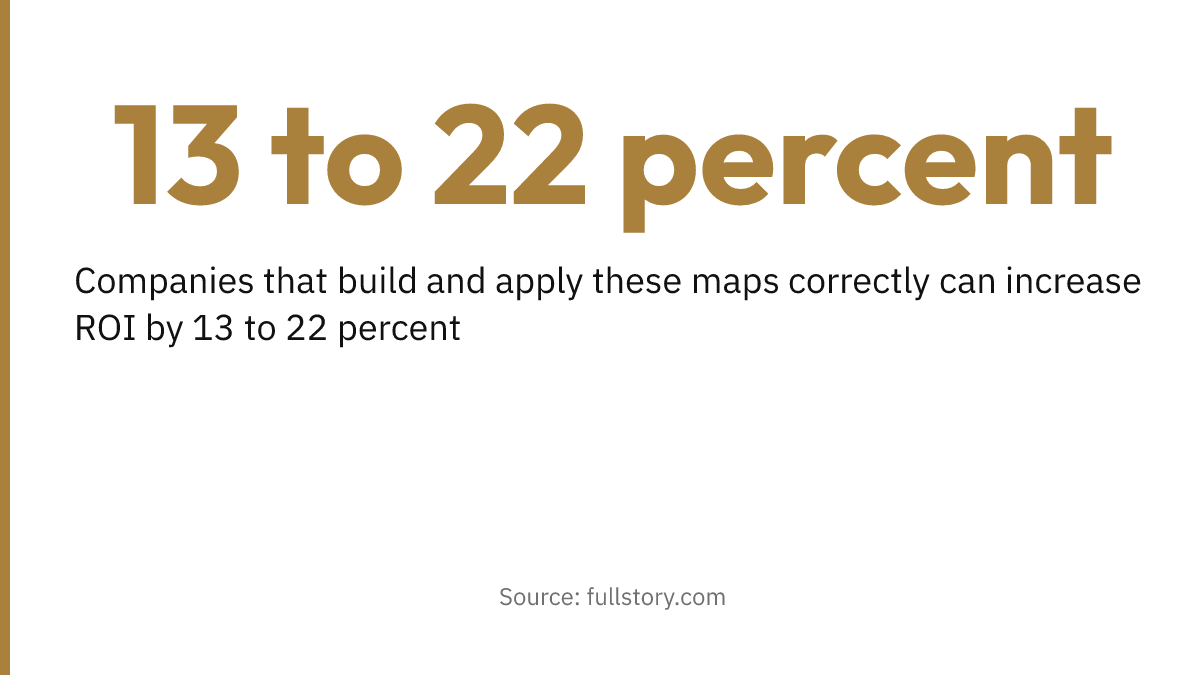
The most direct business case is revenue. According to Fullstory, customer journey maps are known to help businesses increase their ROI by 13 to 22 percent when done correctly. That improvement comes from fixing friction that was quietly costing sales.
The benefits behind that improvement fall into a few clear categories:
- Pain point identification. A map shows exactly where customers drop off, get confused, or abandon a purchase, so you know which problems to fix first.
- Experience consistency. Mapping every touchpoint reveals where the experience breaks down between channels, such as when an ad promises something the product page doesn’t deliver.
- Team alignment. When everyone handling marketing, customer service, and operations works from the same map, decisions are based on shared customer data rather than assumptions.
- Prioritization clarity. A map shows which friction points affect the most customers, so you can direct budget and effort toward the changes with the strongest potential return.
For a store selling high-ticket products, that last point carries extra weight. Buyers are careful and purchases are infrequent, so a single friction point in checkout or after an inquiry can mean a meaningful amount of lost revenue. Fixing the right problem pays off far more than fixing low-stakes friction in a low-ticket store.
Data-Driven Approach in Customer Journey Mapping
Assumptions about what customers want have a poor track record in e-commerce. A map built on guesswork shows what you hope is happening rather than what customers are actually doing, and the gap between the two is where revenue gets lost.
Fullstory stresses that journey maps should be built on real customer behaviors, not assumptions, so they reflect actual actions, attitudes, and emotions. That grounding in observed reality is what separates a useful map from a document that makes everyone feel productive for an afternoon.
What Real Data Looks Like in Practice
Collecting real customer behavior means drawing from several sources rather than relying on one. A well-built map typically pulls from:
- Session recordings. These show exactly where visitors pause, scroll back, or leave a page, revealing friction that surveys would never surface.
- Purchase and return records. Transaction histories show what customers buy together, when they return products, and which categories drive repeat visits.
- Customer support logs. Recurring complaints and questions point directly to the touchpoints where your messaging or product information is failing.
- On-site search queries. What customers search for inside your store tells you what they expected to find but couldn’t.
Brook Hiddink, founder of High Ticket, makes the same point about watching real behavior. In an interview with WebProNews, he recommends tools like Lucky Orange to track how people use your site, so you can see where potential customers get stuck and fix common usability issues.
Why Assumptions Produce Costly Gaps
When a map is built from internal opinions rather than customer data, it tends to flatter the business. Friction points get left out because no one on the team experiences them firsthand, and the checkout flow looks clean on paper while real customers are hitting unexpected shipping costs and leaving.
A data-driven map forces the uncomfortable parts into view, and those are exactly the areas where fixing the experience improves conversion rates and average order value. Without real behavioral data, there’s no reliable way to tell a genuine obstacle from a non-issue, and optimization effort goes to the wrong places.
Enhancing Customer Journey Mapping with AI Tools
Manual journey mapping surfaces patterns, but it moves at the speed of human review, and customer behavior changes faster than that. AI tools can help close the gap by processing behavioral signals, session data, and interaction logs at a scale that’s hard to match by hand.
This shifts the work from describing what happened toward spotting where friction is likely to appear next. A visitor who stalls on a product page and never returns is easy to miss in a summary report, but an AI layer can flag that pattern across hundreds of similar sessions and bring it to your attention.
The practical benefits of bringing AI into the mapping process include:
- Pattern recognition. AI can scan large volumes of interaction data and group similar behaviors into stages or segments much faster than manual analysis.
- Fresher data. Tools connected to live data sources let your map reflect current customer behavior rather than a snapshot from last quarter.
- Faster prioritization. Instead of debating which pain point matters most, you can use AI-assisted analysis to see which issues affect the most visitors.
- A shared reference point. Data-based visualizations give everyone involved a common view, instead of competing interpretations of the same anecdotal feedback.
For a store built around high-consideration products, buyers typically interact with your brand across several sessions and channels before converting. Understanding exactly where that journey breaks down takes more than a diagram assembled once by hand.
Using Journey Mapping to Improve Your Store
Customer journey mapping works because it replaces guesswork with an evidence-based view of how real people move through your store. A map is only as useful as the data feeding it: qualitative feedback tells you where friction exists, and quantitative data tells you how often it happens and how much revenue it costs.
Used together, they give you a way to prioritize, rather than a list of things to fix someday. The value shows up in three areas:
- Touchpoint clarity. You can see exactly which steps in the buying process are losing customers, so you fix the right thing instead of the loudest thing.
- Segment precision. Different buyer types behave differently in the same funnel. Fullstory recommends mapping different customer segments separately to reflect their distinct experiences, behaviors, and needs.
- Faster iteration. When behavioral data surfaces problems quickly, you can test a fix and measure the result in days rather than months.
Keep the map current, too. Fullstory advises updating journey maps regularly to reflect changing customer behaviors and needs, especially when you launch a new product or your business goals shift.
For a high-ticket store, where a single lost sale can mean thousands of dollars in missed revenue, converting existing traffic well often matters more than buying more of it. Hiddink illustrates the math in his WebProNews interview: at $1,000 profit per sale, a store needs only 25 sales a month to reach $25,000 in monthly profit. With so few sales needed, every recovered buyer counts.
If you want a step-by-step system for building and optimizing a high-ticket store, from finding suppliers to building your Shopify store and running ads, explore the High Ticket E-Commerce course. Results are not guaranteed and depend on individual effort, market conditions, and personal skills.
Frequently Asked Questions
What is the main purpose of a customer journey map?
A customer journey map shows every interaction a customer has with your brand, so you can see the experience from their point of view. Its main purpose is to reveal where customers get stuck, confused, or drop off, so you can fix those points and improve conversions.
What are the key components of a customer journey map?
Most maps include the stages of the journey, the touchpoints at each stage, what the customer does, and how they feel along the way. Many also include pain points and opportunities, which are the areas where the experience can be improved.
What data should a customer journey map be based on?
A strong map draws on real customer behavior rather than assumptions. Useful sources include session recordings, purchase and return records, customer support logs, on-site search queries, and customer surveys. Combining several sources gives you a more accurate picture than relying on any single one.
How often should you update a customer journey map?
Update your map whenever customer behavior, your products, or your business goals change, such as after launching a new product or changing your checkout process. Reviewing it regularly with fresh data keeps it useful rather than letting it go stale.
Why does customer journey mapping matter for high-ticket stores?
High-ticket buyers research carefully, buy infrequently, and often visit several times before purchasing. Because each sale carries a large profit, losing a buyer at the wrong stage is costly. A journey map shows exactly where those buyers drop off, so you can fix the problem instead of simply spending more on ads.