

Most people building their first sales funnel optimize for volume. More clicks, more leads, more eyeballs. That logic works fine when you’re selling a $29 product, but it falls apart the moment you’re selling something priced at $3,000 or above. I learned this the expensive way, running low-ticket stores that lived and died by traffic volume before I ever touched high-ticket dropshipping.
High-ticket sales funnels work differently because buyers aren’t making an impulse decision. They’re weighing the potential return against the risk of making a costly mistake. That means a funnel can generate plenty of leads and still fail if those leads don’t trust the offer, understand its value, or feel confident enough to take the next step.
In this guide, I’ll break down what a high-ticket sales funnel actually looks like, what each stage needs to accomplish, and how to remove the friction that causes qualified prospects to drop off before they buy.
But first:
What is a High-Ticket Funnel?
A high-ticket funnel is a sales and marketing system built to sell products or services priced at $3,000 or more. Instead of optimizing for volume like a typical funnel does, it filters for high-end buyers and builds enough trust to justify a big purchase.
A few examples of what this looks like in practice:
- A high-ticket e-commerce store selling $4,000 home saunas runs Google Shopping ads to buyers already searching for the product, then uses retargeting and a detailed product page to answer objections before the buyer ever reaches checkout.
- A coaching or consulting offer priced at $8,000 uses an application form and a pre-call video to filter out unqualified leads before a sales call happens, since the service can’t be inspected the way a physical product can.
- A B2B software deal above $10,000 stretches the funnel across weeks or months and often needs to hold the attention of more than one decision-maker, not just the person who first clicked the ad.
Why High-Ticket Funnels Are Built to Filter
In a high-ticket funnel, your job at every stage is to pre-qualify the prospect, not chase a conversion rate. You’re not trying to close everyone who opts in. You’re trying to surface buyers who are actually ready and quietly filter out tire-kickers before they eat into your time.
Build Friction Into the Funnel on Purpose
Application forms, pre-call questionnaires, and content that naturally self-selects for serious buyers all do this job. If your funnel is too frictionless, you end up talking to the wrong people all day, and every one of those calls costs you time you could have spent closing someone who was actually ready.
Build the Warm Audience Before You Build the Funnel
A warm audience needs to exist before the funnel does, not the other way around. YouTube content, a free community, an email nurture sequence, organic social… whatever channel fits your brand, you want people who already know who you are before you ask them to consider spending four figures. Once you have that audience, build the funnel around it.
Read more: How to build a lead generation funnel that actually converts covers how to build that qualification layer without killing your volume entirely.
High Ticket Sales Funnel Stages
Most people underestimate how long a high-ticket sales cycle actually takes. They launch a funnel, run some ads, and expect buyers to convert within a day or two. This rarely works when the decision involves $3,000, $8,000, or $15,000.
The higher the price, the more time buyers usually need to research, compare options, assess credibility, and justify the investment. This longer decision process shapes every stage of the funnel. Here are the main high-ticket sales funnel stages:
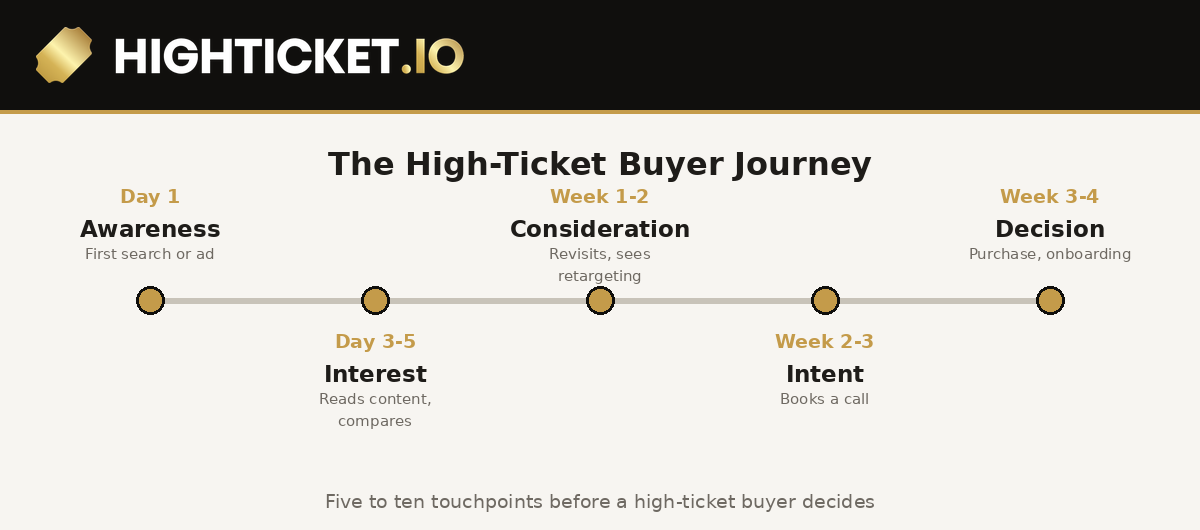
Stage 1: Awareness
At the awareness stage, the goal is to get the brand in front of people who have a problem, are actively looking for a solution, and may eventually become customers.
A high-ticket buyer rarely lands on a website for the first time and immediately pulls out a credit card. They search Google, compare providers, read reviews, watch videos, and look for evidence that a company can deliver what it promises. By the time they are ready to talk to sales, they may have encountered the same brand several times.
This makes intent-based acquisition valuable. Google Search Ads, SEO, and retargeting can put the brand in front of people already researching a solution, rather than trying to manufacture demand from scratch. Someone searching for enterprise software or high-end consulting, for example, has already recognised a problem and is actively exploring their options. Your sales funnel simply needs to make sure your brand is one of those options.
Stage 2: Consideration
This is where many high-ticket funnels lose the sale. A prospect finds the product, browses the site, and leaves without buying. This doesn’t necessarily mean they aren’t interested. They may simply need more information, more reassurance, or more time to decide.
The problem is that many funnels do nothing to support that decision once the prospect leaves. Retargeting gives browsers a reason to return, whether that’s through a reminder, useful content, a relevant offer, or another touchpoint that keeps the brand in the conversation.
The product or service page equally needs to answer the questions that could stop someone from buying. For instance:
- Will this work for me?
- What happens if something goes wrong?
- Who is behind the product?
- Why should I choose this over the alternatives?
Strong product pages address those objections before prospects search elsewhere.
In this case, add trust signals to reinforce that decision. Warranties, guarantees, customer testimonials, case studies, certifications, and named supplier relationships should appear where buyers need reassurance, not buried in a footer or tucked away on another page. For example, I included testimonials of my past students right at the center of highticket’s homepage:
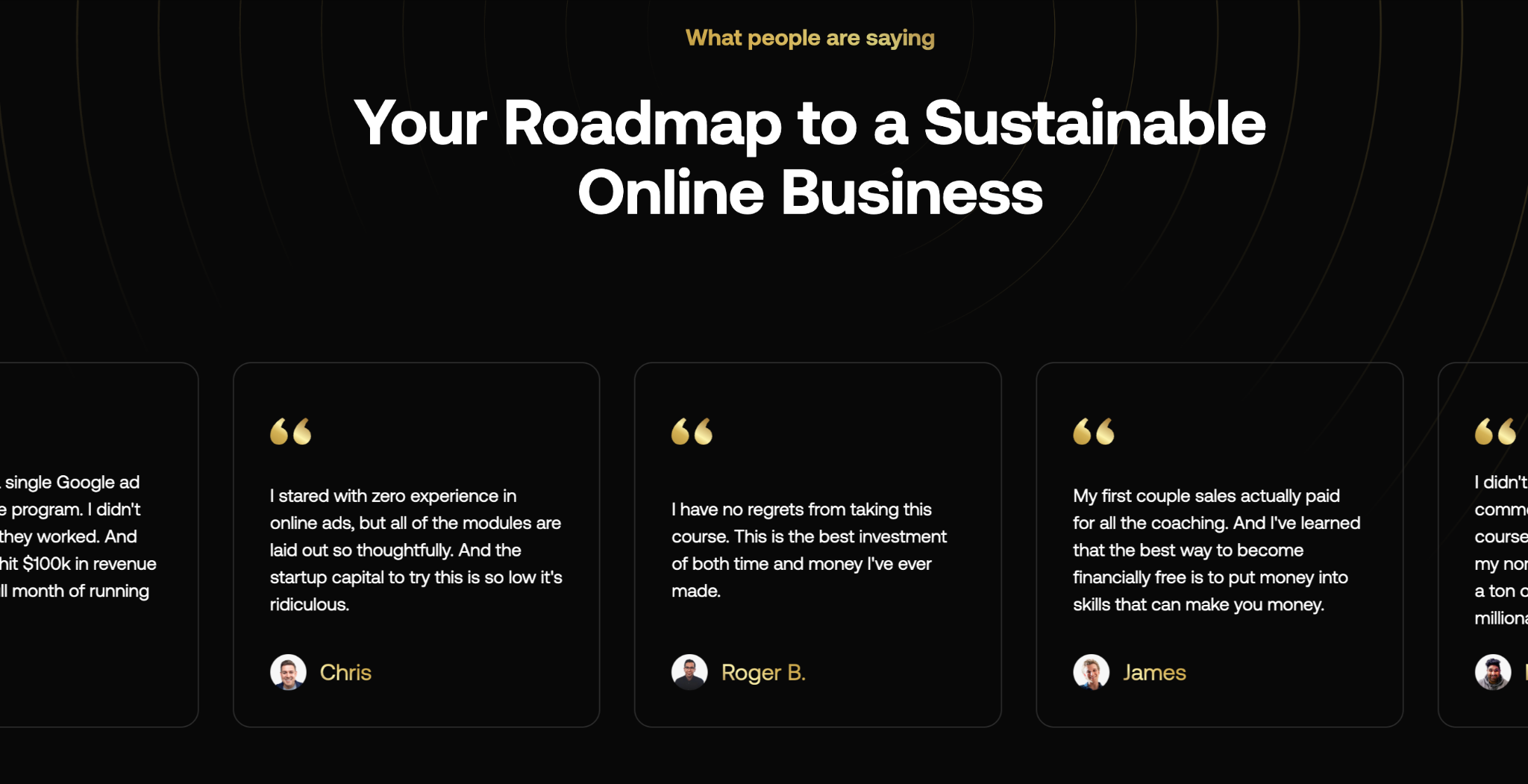
The goal of the consideration stage is to remove the reasons they might hesitate, leave, and choose a competitor instead.
Stage 3: Decision
By the time a prospect reaches the decision stage, they have already done most of the heavy lifting. They know what they need, they’ve researched their options, and they’ve spent time deciding whether your product or service is worth the investment. At this point, another urgency tactic rarely moves the needle. Basically, your prospects don’t need more pressure. They need a reason to feel confident about taking the final step. This changes what the funnel should focus on. Instead of throwing another discount or countdown timer at the buyer, remove the small uncertainties that can turn a ready-to-buy prospect into a lost sale. Basically:
- Have a clear pricing plan
- Keep the checkout or enquiry process straightforward
- Make delivery, installation, warranties, payment terms, and post-purchase support easy to understand.
Responsive human support becomes just as important. High-ticket buyers often have one or two questions before making the final purchase. For instance, they may want to confirm whether a product will work in their space, clarify a specification, understand the installation process, or simply speak to someone before spending thousands. A fast, knowledgeable response can provide the final piece of reassurance they need.
Condition the Prospect Before the Call
By the time a prospect gets on a call with you, the decision should already be about 80% made. That’s the entire job of a pre-sell funnel. Most people treat the confirmation page after an opt-in as dead air. It isn’t. It’s the first place you get to shape how a prospect sees themselves relative to your offer.
What a Functional Pre-Sell Sequence Actually Does
A functional pre-sell sequence reinforces that the buyer is making an active choice. It also:
- Builds credibility through specific, verifiable proof instead of vague claims. Case studies, client outcomes, demonstrations, and relevant experience give prospects something concrete to evaluate before the call.
- Sets expectations around who the offer is for and, just as importantly, who it isn’t for. This helps prospects self-qualify and prevents sales conversations with people who are unlikely to benefit from the offer.
- Reduces no-shows by creating a sense of earned access. When prospects understand why the call exists, what will happen during it, and what they need to bring, the appointment feels like a meaningful next step rather than another sales call.
- Answers the obvious questions before the call. The sequence can address common concerns about pricing, implementation, timelines, results, fit, or what working together actually looks like, so the call doesn’t have to start from zero.
- Moves the prospect from curiosity to evaluation. The goal is to give them enough context to decide whether having the conversation makes sense.
- Creates continuity between the marketing and sales experience.
Overall, the best pre-sell sequences make the prospect better informed, better qualified, and more prepared to decide.
The Confirmation Page
The confirmation page is more than a simple “Your call is booked” message. It is the first opportunity to shape what happens between booking and the actual conversation.
Use the page to restate the call’s value in concrete terms and tell the prospect exactly what to prepare and what the call will cover. Specificity signals a professional, structured process. For example, instead of saying, “One of our experts will speak with you about your goals,” explain what the conversation will actually accomplish: where the prospect is now, what is preventing progress, what options could address the problem, and whether the offer is a suitable fit.
The page can also include practical details such as:
- How long the call will take
- Who the prospect will be speaking with
- What information or documents to have ready
- What will be discussed during the call
- Whether other decision-makers should attend
- What happens after the call
- A clear way to reschedule if something comes up
This matters because uncertainty creates friction. A prospect who doesn’t know what will happen on a high-ticket sales call has more reasons to postpone, cancel, or show up unprepared.
A strong confirmation page removes that uncertainty before it becomes a problem. It tells the prospect, in effect, “Here's what you committed to, here's why the conversation is useful, and here's how to get the most from it.”
Use a Pre-Call Video or VSL to Do the Heavy Lifting
A short video between confirmation and the call is one of the highest-leverage touchpoints in the entire funnel. It should cover your story, your proof, and the framework you teach, roughly in that order, and it should stay under fifteen minutes. The goal here is to make the prospects feel informed and confident before they speak to anyone on your team.
Which Funnel Metrics Actually Matter
Click-through rate and cost per lead tell you how many people showed up. They don’t tell you whether the right people showed up, so they’re the wrong scorecard for a high-ticket funnel. Track these instead:
- Cost per qualified call booked — This shows what you’re actually paying to get a sales opportunity
- Show rate on discovery calls — A low show rate usually points to weak qualification, poor pre-call communication, or a prospect who never developed enough intent to attend.
- Days from first touch to sale — This tells you whether your funnel matches the sales cycle your offer actually needs.
- Call-to-close rate — This shows whether qualified prospects convert once they reach the sales conversation. If this number is low, look at lead quality, offer fit, and the sales process before simply sending more traffic.
- Customer acquisition cost (CAC) — Calculate the total cost of acquiring a customer, including advertising, sales, software, and other funnel expenses. This gives you a much more realistic picture of profitability than cost per lead.
- Revenue per qualified call — This connects your marketing directly to revenue. If each qualified call generates more revenue on average, the funnel can support higher acquisition costs without sacrificing profitability.
High-Ticket Sales Come Down to the Buyer’s Pain Point
Every tactic in this guide collapses without this. You can build the cleanest funnel architecture, run perfectly targeted intent-based ads, and nail your pre-sell sequence, and still lose the sale if you never understood what your buyer actually needed to solve.
That said, lead with the problem in your ad copy. Mirror the language your buyers use in reviews and forums, and structure your VSL or application page around the cost of inaction.
Read more: Sales funnels for physical products
How to Build a High Ticket Sales Funnel Step by Step
Here’s how to build a high-ticket sales funnel:
Step 1: Define the Offer and the Buyer Who’s Ready for It
Get specific about what you’re selling and who will actually buy it, before you build anything else. “Coaching” or “consulting” isn’t specific enough, because nobody can write ad copy, a landing page, or a pre-call video for a service that vague. There’s nothing there to build around yet.
Answer three questions in writing before you move on:
- What outcome does the buyer walk away with? Not “better sales skills,” but “a repeatable outbound process that books 10 qualified calls a month.”
- What’s the timeframe? A 90-day program and a lifetime membership are two different sales, with two different funnels, even at the same price.
- Does the price match the outcome? A $3,000 program promising a vague “mindset shift” is a much harder sell than a $3,000 program promising a specific, measurable result the buyer can picture.
Practically, “I help people grow their business” gives the funnel almost nothing to work with. It doesn’t tell the prospect what growth means, how it happens, who the service is designed for, or why they should pay for it. However, “I help B2B service businesses build an outbound system that generates 10 qualified sales calls a month within 90 days” is more defined, with a clear outcome and a timeframe. Those details give you something concrete to build the rest of the funnel around.
The clearer you define the offer and the buyer, the easier it becomes to create messaging, proof, and qualification around problems they already understand.
Step 2: Build a Warm Audience Before You Spend on Ads
High-ticket buyers rarely see an offer once and immediately book a call. They need enough exposure to the problem, the solution, and your expertise before they’re willing to consider a $3,000+ purchase. That’s why building a warm audience first makes the rest of the funnel easier and more efficient.
Publish at least one useful piece of content a week that answers a question your future buyer is already asking, on whichever channel best fits your audience. Focus on content that demonstrates how you think, addresses common objections, and gives prospects a reason to trust your expertise before you ever ask them to buy.
You don’t need a massive audience before running ads. A useful benchmark might be 500 engaged email subscribers or around 1,000 genuinely engaged followers, but audience quality matters more than the number. If those people match your ideal buyer and regularly interact with your content, you have a foundation to build on. If you launch ads to cold strangers before that foundation exists, every ad has to build trust and ask for money in the same interaction. Warm traffic only has to clear the second hurdle.
Step 3: Validate the Offer Manually With a Shadow Funnel
Before you build any of the funnel structure below, you need proof the offer itself actually sells, not just that people say they’re interested when you ask casually. A landing page and an ad budget can make a weak offer look busy without ever telling you whether it converts into real money.
Message 20 to 30 people who fit your buyer profile directly, on LinkedIn, in a community, or by email, and try to close three to five paying clients through real conversation. This is sometimes called a “shadow funnel.” It’s slower than launching ads, but it’s the cheapest way to find out an offer doesn’t work before you’ve spent money trying to prove otherwise.
Step 4: Build the Minimum Funnel Structure
Once you’ve proven the offer manually, the only thing missing is a way to repeat those conversations without doing every part of them by hand. Building more than that before you have real volume solves a problem you don’t have yet.
Build exactly three things: a landing page using the language your manually closed clients actually responded to, a pre-sell asset that answers the questions they asked you personally, and a booking link. Skip the CRM and the membership site for now. They feel like progress, but at this stage, complexity is standing in for the proof you still need.
Step 5: Layer In the Pre-Sell Sequence
A prospect who books a call with nothing but a calendar invite arrives with zero context, which means the first ten minutes of the call get spent on rapport and explanation instead of moving toward a decision. The pre-sell sequence does that work in advance.
Add the confirmation page and pre-call video covered earlier before the call, not after you notice low close rates. Most builders skip this step because it doesn’t feel as essential as the sales call itself, and it usually takes a few weak calls before the connection becomes obvious.
Step 6: Add Consideration-Stage Assets
Most people who see your offer will leave without booking on the first visit; a $5,000 decision doesn’t happen on visit one for almost anyone. Without something bringing that majority back, you’re relying entirely on the small minority who convert immediately, and that’s a much smaller number than it needs to be.
Three things cover most of this: a retargeting ad aimed at people who visited but didn’t book, three to five common objections answered directly on the offer page, and one visible trust signal, a guarantee, a named supplier, a real photo instead of a stock image. None of this needs to be elaborate. One ad and a handful of honest answers usually beats a complicated sequence nobody finishes building.
Common Mistakes That Kill High-Ticket Funnels
- You treat it like a low-ticket funnel. You remove all the friction and chase volume, and the tactic backfires instead of helping.
- You run cold traffic straight at the offer. Without warming up the audience first, you pay to build trust and convert in the same click.
- You skip the pre-sell sequence. A prospect who walks into a call cold takes longer to close, if they close at all.
- You use urgency tactics at the decision stage. Countdown timers and fake scarcity read as red flags to a buyer who weighs a five-figure purchase.
- You track vanity metrics. Cost per lead and click-through rate won’t tell you where a high-ticket funnel actually leaks.
- You automate before you validate. Build the full funnel before you close a single sale manually, and you scale a guess instead of a proven offer.
Bottom Line
A high-ticket funnel isn’t a bigger, more expensive version of a low-ticket one. It runs on qualification instead of volume, a longer sales cycle instead of a fast one, and trust instead of urgency. Build the audience first, validate the offer manually, then automate only what’s already proven to convert. If your current funnel underperforms, the fastest thing to check is show rate and close rate by source, since that’s usually where the real leak hides.
Frequently Asked Questions
What Is a High-Ticket Sales Funnel?
A high-ticket sales funnel is a marketing and sales system built to sell products or services priced at $3,000 or more. Instead of optimizing for volume, it prioritizes qualification, trust-building, and a longer nurture sequence, since buyers at this price point research extensively before committing.
How Long Does a High-Ticket Sales Cycle Typically Take?
Most high-ticket purchases take anywhere from several days to a few weeks to close, compared to minutes for a low-ticket impulse buy. The exact length depends on price point and niche, but the funnel needs to hold a prospect’s attention across multiple touchpoints rather than a single visit.
What Does a Pre-Sell Sequence Do?
A pre-sell sequence is the set of touchpoints, confirmation pages, videos, and follow-up emails that runs between a prospect opting in and getting on a call. Its job is to build trust and set expectations in advance, so the prospect arrives on the call already leaning toward buying.
Do High-Ticket Funnels Need Paid Traffic to Work?
Not at the start. Validating an offer manually through direct outreach, what’s often called a shadow funnel, is the recommended first step. Add paid traffic and automation only after the offer has proven it can convert through manual conversations.