

A sales funnel maps the customer journey as they move toward purchasing, the path someone walks from first discovering your store all the way to clicking “place order.” Every stage either moves them forward or loses them. This article covers the four stages of a working funnel, what content each stage needs, how to automate the system, and what to fix when conversions stall.
Key takeaways
- A sales funnel maps the customer journey from first contact to purchase, giving you a system to guide prospects rather than leaving conversions to chance.
- The AIDA model, Awareness, Interest, Decision, Action, gives you a clear framework for structuring every stage of your funnel.
- Funnel building is the strategic process of creating automated marketing and sales systems that guide potential customers through their buying journey.
- A sales funnel provides visibility into the effectiveness of your sales and marketing approaches, making it easier to spot where revenue is leaking.
- Optimizing one stage at a time, guided by real data, is what separates stores that scale from stores that stall.
Prerequisites for Building a Sales Funnel
Before you map out stages and write copy, make sure the right tools are in place. Jumping into funnel-building without the basics means spending money with no way to measure what is working.
Here is what you need before you touch anything else.
A Platform to Host Your Store and Landing Pages
You need somewhere for your funnel to live. For most high-ticket e-commerce stores, that means Shopify as your core storefront, paired with a landing page builder for dedicated funnel pages.
Shopify handles your product pages and checkout. A landing page tool lets you build focused, distraction-free pages for lead gen campaigns, capturing emails or phone numbers before sending visitors to a product page.
A Way to Capture and Manage Leads
Lead gen fuels your funnel. You need an email marketing platform to follow up with people who did not buy on their first visit.
Pick a platform that lets you build automated sequences. When someone opts in, the follow-up should happen without you manually hitting send every time.
Google Ads Access and Basic Analytics
Most high-ticket stores run Google Ads as their primary paid traffic source. Set up your Google Ads account and connect Google Analytics to your store before you build anything else.
This gives you the data layer to see where visitors drop off inside your funnel. Without it, you are guessing at what to fix.
The Marketing Knowledge You Actually Need
You do not need a marketing degree, but you do need a working understanding of who your target customer is and what problem your product solves, how to write a basic offer with a clear price and reason to buy, and what a conversion rate means, the percentage of visitors who take a desired action like buying or opting in.
That is your real prerequisite list. Platform, lead capture, traffic source, and a clear customer in mind. Get those four sorted and you are ready to build.
Step 1: Define Your Sales Funnel Stages
Most people hear “sales funnel” and picture some complicated diagram with seventeen boxes and arrows going everywhere. Your funnel is really just a map of how a stranger becomes a buyer, and getting that map right is what makes everything else click into place.
The framework that works cleanly for high-ticket e-commerce is the AIDA model - Awareness, Interest, Decision, and Action, which describes the four stages your customer moves through before they hand over their credit card.
Awareness
Awareness is where someone discovers you exist for the first time, before any purchase intent has formed. Your job at this stage is one thing only: get on their radar with something genuinely useful.
Interest
Now they are paying attention. They are reading your product pages, watching your content, maybe signing up for your email list. At this stage, case studies and real-world results do heavy lifting. A customer who sees a detailed breakdown of how a product solved a real problem is far more convinced than one who reads a generic product description.
Decision
This is where the buyer compares options and looks for reasons to commit. Think reviews, detailed specs, guarantee language, and trust signals. High-ticket buyers research carefully before committing, so your store needs to answer the objections that naturally arise when someone considers a significant purchase.
Action
The customer buys, but a well-structured action stage does not stop there. It includes a smooth checkout and a clear post-purchase confirmation that reinforces they made the right call.
Map your store against each of these four stages before you write a single word of copy. Whichever stage shows the sharpest drop in visitor progress is where your effort belongs first.
Step 2: Create Content for Each Stage
Now that your funnel stages are mapped out, the next question is what you actually put in each one. Most store owners create one type of content and blast it at everyone, which is where the problems start. Someone who just discovered your brand needs something completely different from someone who already added a product to their cart.
Top-of-Funnel Content: Attract and Educate
At this stage, your audience has not found you yet and is searching for answers rather than products. Your job is to show up with something genuinely useful before you ask for anything in return, blog posts that answer common questions in your niche, short-form videos on social media that introduce the problem your products solve, and YouTube content that builds familiarity over time.
- Write educational blog posts targeting informational search terms
- Post short videos on social media platforms like YouTube, TikTok, and Instagram Reels
- Share behind-the-scenes content that makes your brand feel real and relatable
The priority at this stage is reach and building trust, not closing a sale.
Middle-of-Funnel Content: Build Trust and Consideration
Your prospect knows you exist. Now they are evaluating whether to trust you enough to spend real money. This is where the high-ticket model lives or dies.
Product comparison pages, detailed how-it-works guides, and customer testimonials all do heavy lifting here. If you ship to customers across regions, clear delivery and quality guarantees matter enormously at this stage.
- Create detailed product pages with specs, use cases, and FAQs
- Publish testimonials and real customer stories (results are individual and not typical)
- Use email sequences to nurture leads who did not buy on the first visit
Bottom-of-Funnel Content: Remove the Last Objection
A bottom-of-funnel visitor has already done the research and is weighing whether to commit. A limited-time offer, a direct comparison of your product versus the alternative of doing nothing, or a personal video explaining exactly what they get can close that gap.
Real results, real numbers win here. Show proof, remove doubt, and make the next step impossible to miss.
Step 3: Implement and Automate Your Funnel
You have defined your stages and built your content. Now it is time to wire everything together so the funnel runs without you manually chasing every lead.
That is the point of funnel building: creating automated marketing and sales systems that guide potential customers through their buying journey.
Set Up Your Automation Sequences
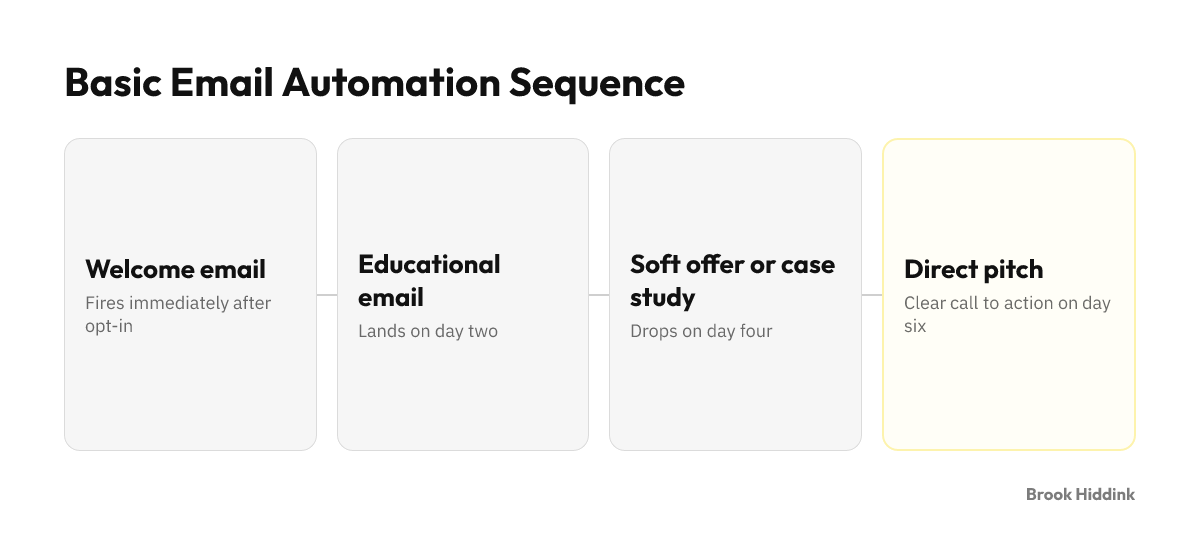
Start with your email platform and connect it directly to your Shopify store. Every opt-in, cart abandonment, or post-purchase action should automatically trigger a pre-written sequence.
Here is the basic sequence to build first:
- Welcome email fires promptly after opt-in
- Educational email lands on day two
- Soft offer or case study drops on day four
- Direct pitch with a clear call to action goes out on day six
Each email should push the reader one step forward, nothing more.
Connect Your Tools So Nothing Falls Through the Cracks
Predictable revenue comes from systems, not heroics. Your Shopify store, email platform, and ad pixels need to talk to each other. If a lead buys, they should automatically exit the nurture sequence. If they abandon a product page, a retargeting ad should follow them within hours.
Run a quick audit after setup. Open an incognito browser, opt into your own funnel, and walk every step as a customer would. Check that each trigger fires, each email arrives, and each retargeting tag loads correctly.
The rule is simple: automate first, scale second. A leaky funnel at low traffic is a disaster at high traffic.
Step 4: Analyze and Optimize Your Funnel
Your funnel is live. Traffic is moving through it. Now comes the part that actually separates stores that scale from stores that stall: looking at the numbers and knowing what to do with them.
A sales funnel gives you visibility into the effectiveness of your sales approaches and marketing efforts, so you can see exactly which stages are working and which are leaking revenue. Without that visibility, you are guessing, and guessing is expensive in high-ticket e-commerce.
Track the Metrics That Actually Matter
Start with these four checkpoints:
- Awareness-to-interest rate: What percentage of visitors move from your landing page to your lead magnet or next step?
- Interest-to-consideration rate: Are leads opening your emails, watching your content, and clicking through to product pages?
- Consideration-to-intent rate: How many people add to cart or request a quote after visiting a product page?
- Intent-to-purchase rate: What percentage of cart-adders or quote-requesters actually convert?
If one stage drops sharply, that is your bottleneck. Fix that before scaling ad spend.
Run Systematic Tests
Do not change five things at once. Pick one variable per test, your headline, your call-to-action button, or your follow-up email sequence, and run it long enough to collect meaningful data. Small copy and layout changes at the consideration stage can meaningfully shift conversion rates, so treat every page in your funnel as a hypothesis rather than a finished product.
Apply a Regional Lens When Relevant
If your store targets buyers across multiple regions, segment your funnel data by geography. Conversion behavior, price sensitivity, and decision timelines vary. Optimizing a single aggregate number can hide an underperforming regional segment pulling your overall rate down.
Funnel optimization is an ongoing process, not a one-time task. Review your stage-by-stage data regularly, test one change at a time, and let real numbers drive every decision.
Troubleshooting Common Funnel Issues
At some point, most funnels hit a wall: traffic comes in but conversions stall, or leads opt in and then go quiet without ever buying. If you are staring at your analytics wondering what went wrong, the key is identifying which specific problem you are dealing with before you start changing things.
Low Conversion Rate at the Top of Funnel
This usually means your traffic and your offer are misaligned. Ask yourself: is the person clicking your ad the same person your product is built for?
Check your ad targeting first. Then audit your landing page headline, does it speak directly to the pain your visitor arrived with? Tighten the message match between your ad copy and your page copy, and watch your opt-in rate respond.
High Drop-Off at the Checkout Stage
Visitors add to cart but disappear before they pay. Nine times out of ten, this comes down to trust. High-ticket buyers need more reassurance than low-ticket ones.
Add trust signals, clear return policies, direct contact options, and real product imagery. If you serve buyers across multiple markets or languages, make sure your checkout and support language reflect that, because language friction quietly kills conversions.
Leads Who Never Re-Engage
Your email list is growing, but your open rates are flat. The fix is segmentation. Stop sending every lead the same sequence and start triggering messages based on behavior, pages visited, products viewed, cart abandoned.
The real troubleshooting move is this: identify the one stage where the biggest volume drops off, fix that single point, and measure before touching anything else. Scattered changes produce scattered data. One variable at a time gives you real results, real numbers.
Frequently asked questions
How to create a sales funnel for free
You can build a basic sales funnel using free tiers of email marketing platforms combined with your existing Shopify store pages and organic social media content. The core structure, awareness content, a lead capture page, and an automated email sequence, does not require paid tools to get started. As volume grows, paid tools add speed and scale, but the framework itself costs nothing to map out and test.
How to create a sales funnel template
A sales funnel template maps each stage of the AIDA model to a specific page or touchpoint: an awareness-stage blog post or ad, an interest-stage landing page with a lead magnet, a decision-stage product or comparison page, and an action-stage checkout with post-purchase confirmation.
Write out each stage as a row, note the content type, the conversion goal, and the next step a visitor should take. That document becomes your working template before you build anything in a tool.
How to create a sales funnel example
A straightforward example for a high-ticket e-commerce store looks like this: a Google Shopping ad drives a visitor to a product category page (Awareness), they opt into an email list for a buying guide (Interest), a nurture sequence delivers detailed product comparisons and testimonials (Decision), and a direct offer email with a clear call to action closes the sale (Action). Each stage hands off cleanly to the next, and every touchpoint has one job.
What is a sales funnel example?
A sales funnel tracks potential customers from initial contact to purchase. A practical example is a store that runs a blog post targeting an informational search term, collects emails from readers via a free guide, follows up with an automated sequence that builds trust, and converts subscribers into buyers through a direct product offer. The funnel makes the customer journey visible and manageable at every step.
How can I create a free sales funnel?
Start with a free email marketing platform, your existing store pages, and organic content on social media or a blog. Map the four AIDA stages, assign a piece of existing or easy-to-create content to each one, and connect them with a free automated email sequence. The most important investment is time spent understanding your customer and writing copy that speaks to their specific problem, the tools are secondary to getting that right.