
A conversion funnel is an operating system that decides whether a $3,000 product page turns a browser into a buyer, or just another line in the bounce rate. Every stage between the first ad impression and the final checkout click either moves a prospect closer to a purchase or gives them a reason to leave. For high-ticket e-commerce, where a single sale carries real weight, understanding how a funnel guides that journey and building each stage to match the way high-ticket buyers think, decide, and hesitate is the difference between a store that converts and one that accumulates traffic.
Conversion Funnels Guide Consumers Through the Buying Journey
Most people who land on your store are not ready to buy. They are browsing, comparing, maybe vaguely curious. Without a deliberate structure pulling them forward, they leave. That is the core problem a sales funnel solves.
Conversion funnels guide consumers through the buying journey, ensuring they land exactly where you want them to. In high-ticket e-commerce, where a single sale can be worth $3,000 or more, getting that journey right is the difference between a store that produces revenue and one that generates traffic with nothing to show for it.
Every touchpoint a shopper encounters, from the first Google Shopping ad they see to the product page they land on to the checkout flow they navigate, needs to serve one specific function at one specific stage. Nothing should be left to chance.
Here is what that means in concrete terms for a high-ticket store:
- Stage-appropriate messaging: A shopper who just discovered a brand needs social proof and credibility signals. A shopper who has visited a product page twice needs urgency and a direct path to purchase. The same message does not serve both.
- Friction reduction at every step: Slow load times, confusing navigation, and unclear calls to action all bleed conversions. Each one is a door that closes before the sale happens.
- Intentional traffic routing: Sending paid traffic to a homepage rather than a targeted landing page dilutes the funnel before it even starts. Every ad should land visitors at the stage-specific page they need.
- Follow-up sequences: High-ticket buyers rarely convert on a first visit. Email and retargeting sequences that re-engage browsers are not optional. They are load-bearing parts of the funnel.
Building this kind of funnel takes real work. But once it runs, it turns browsers into buyers at a predictable rate.
Conversion Funnel Stages Include Awareness, Consideration, and Decision
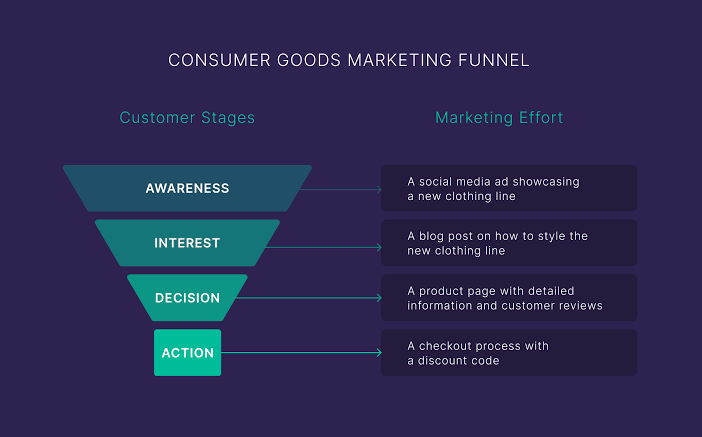
Source: Backlinko
Most stores treat every visitor the same way: the same landing page, the same call to action, the same pitch, regardless of where that person is in their buying journey. That is a fast way to lose sales that should have been won.
The fix is to understand that a funnel has three distinct layers, each requiring a different approach. Here is what each stage actually means for a high-ticket e-commerce store, and what needs to be in front of people at each point.
Awareness
This is the top of the funnel. Someone just discovered a store or product category exists. They are not comparing prices or reading spec sheets. They are figuring out whether this type of product is even right for them.
The job at this stage is education, not selling. Blog content, YouTube videos, and Google Shopping ads that surface a brand for broad category searches all belong here.
Consideration
Now the prospect knows what they want. They are comparing options, reading reviews, and evaluating suppliers. This is where trust becomes the most valuable asset.
Detailed product pages, real supplier relationships clearly communicated, and social proof pull serious weight here. For high-ticket purchases above $3,000, buyers spend significantly more time in this stage than they would for a $30 impulse buy.
Decision
The prospect is ready. Something is stopping them from clicking buy, usually risk: price, shipping uncertainty, return policy, or a question they cannot find the answer to.
This is where live chat, transparent policies, and strong guarantees close the gap. Remove friction. Answer the objection before it becomes a reason to leave.
Sales Funnel Conversion Rate Measures the Percentage of Prospects Who Convert
Most store owners obsess over traffic: more clicks, visitors, ad spend. But the number that actually shows whether a business is working is the sales funnel conversion rate: the percentage of prospects who move through each stage and ultimately take the action you want, whether that is completing a purchase or something else entirely. It also shows where people are dropping off, which stage is leaking revenue, and where effort will have the most impact.
Choosing a Comparison Framework That Works for Your Model
Not every funnel benchmark applies to every business. A high-ticket e-commerce store selling $5,000 products operates on fundamentally different math than a store moving $50 impulse buys. Comparing performance to industry averages without accounting for price point, traffic source, and audience intent leads to chasing the wrong fixes.
Here is how to build a comparison framework that actually fits:
- Price point first: High-ticket products naturally convert at lower percentages. A 0.5% conversion rate on a $5,000 product can outperform a 3% rate on a $40 product in real revenue terms. Set benchmarks relative to average order value, not the category average.
- Stage-by-stage diagnosis: Identify where the drop-off is happening. Is it landing page to add-to-cart? Cart to checkout? Checkout to purchase? Each problem has a different fix, which is exactly what a proper sales funnel analysis is built to surface.
- Traffic source matters: Google Shopping ads bring buyers with commercial intent. Social traffic often brings browsers. Conversion rate will differ significantly between sources, so track them separately.
- Trend over time beats snapshots: A single week of data is noise. Look at 30-day and 90-day conversion trends to identify real movement versus variance, ideally with consistent funnel tracking in place from the start.
The goal is to understand a funnel well enough to improve it, stage by stage, with decisions based on data rather than guesswork.
Overlooked Insights for Sales Conversion Funnels
Most store owners already know the funnel exists. What they miss is how to use it to change behavior at each step, not just the last one.
The foundational definition matters here. A conversion funnel is the visual path that begins with consumers learning about a business and eventually leads them to become customers. That path is not a straight line. People drop off at every stage, and the drop-off points are where the real leverage lives, which is also where a leaky sales funnel tends to show up first.
The Gap Between Awareness and Trust
Traffic without trust converts poorly. In high-ticket e-commerce, a visitor landing on a store for the first time has no reason to hand over $5,000 yet. Awareness-stage content has one job: earn the next click, not the sale. Most stores skip straight to product pages and lose visitors before any trust is built. The fix is to map content to intent. Buyers researching a $4,000 sauna need comparison guides and FAQs before they need a checkout button.
The Hidden Leak at the Consideration Stage
This is where most funnels bleed out. A prospect compares options, hits a question a product page does not answer, and bounces to a competitor. Structured FAQ content and live chat coverage during business hours are the two most overlooked assets here. Both reduce objection-based drop-off without requiring more ad spend.
What Actually Moves the Decision Stage
Price is not always the barrier. At the decision stage, buyers need proof that purchasing is safe. Supplier accreditation, return policies written in plain language, and visible contact information do more work than a discount code. In high-ticket e-commerce, trust infrastructure closes orders. Discounts compress margins on sales that would have happened anyway.
How to Choose the Right Fix for Your Exact Situation
The right funnel strategy depends on where the biggest drop-off lives. Before changing anything, map which stage is bleeding the most visitors. As FullStory explains, conversion funnels help you see how people use your product, spot and solve problems, and improve your website’s overall efficiency, boosting ROI. That is the only reason to care about funnels: not theory, but fixing what is actually broken.
Here is how to match a given situation to the right fix:
- Getting traffic but no add-to-carts: The problem is at the consideration stage. Product pages are not converting browsers into buyers. Add real specifications, high-quality images, and clear delivery timelines. For high-ticket products priced at $3,000 and above, buyers need to feel confident before they click anything.
- Getting add-to-carts but no purchases: The drop is at the decision stage: almost always a trust or friction issue. Reduce checkout steps. Add payment options. Make return policy visible and specific. A buyer spending $5,000 on a product found through a Google Shopping ad needs reassurance that the transaction is safe.
- Getting sales but a flat conversion rate: The funnel is working but not compounding. Run separate campaigns for cold traffic versus warm retargeting audiences. Treat each segment differently, because they are at different stages of the journey and need different messages. A well-timed sales funnel email sequence is often the fastest way to close that gap.
- No baseline data yet: Start by installing tracking before making any changes. You cannot optimize what you cannot measure. Set up Google Analytics goals, connect to Google Merchant Center, and let the data accumulate for at least 4 weeks before drawing conclusions.
Pick the scenario that matches the current situation and work that lever first.
Conversion Funnels Are Crucial for Understanding Customer Journeys
The stages are mapped. The metrics are tracked. Now the real question is what to actually do with all of it.
Funnel data only pays off when it drives decisions, not just reporting. Every drop-off point is a decision waiting to be made.
Fix the Worst Stage First
Ignore the top of the funnel until the middle and bottom convert. One sale from 100 warm prospects beats chasing 10,000 cold clicks. Run the numbers, find the stage with the steepest drop, and fix that before spending another dollar on traffic.
Match the Tool to the Stage
- Awareness: Google Shopping ads to pull in buyers with active purchase intent.
- Consideration: retargeting, detailed product pages, real supplier credibility signals.
- Decision: trust-building content, clear pricing, low-friction checkout.
No single tactic wins across all three. Match the intervention to the location of the leak.
Build and Scale From What Works
Once a stage consistently converts, the result is a repeatable system. That is the whole game in high-ticket e-commerce: not chasing volume, but tightening a process until it produces predictable revenue. Then it gets scaled.
Ready to Tighten Your Funnel?
Every high-ticket store has one stage bleeding more than the others. Finding it and fixing it before scaling traffic is what separates stores that grow predictably from stores that spend more to stand still. For a deeper look at applying this framework to a full-scale funnel build, Brook Hiddink’s guide to high-ticket e-commerce walks through the complete model, and Supplier HQ can help lock in the supplier relationships that make a high-ticket funnel worth running in the first place.